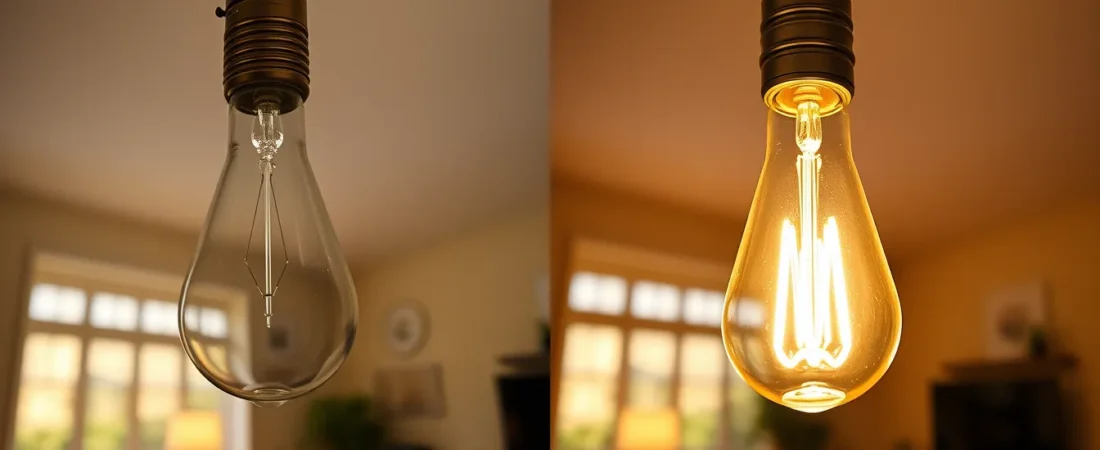
If you are tired of guessing which bulbs save money, this guide cuts through the marketing noise. It explains the basic physics behind LED and incandescent lighting, translating technical terms like efficacy and lumens into practical insights. You will learn how to calculate total cost of ownership, including upfront price, energy usage, and lifespan.
This breakdown helps you choose the right lighting for your specific needs and budget. Whether you want to reduce your electric bill or simply want clearer light, you will find a straightforward path to making the best decision for your home.
How incandescent bulbs generate light and consume energy
Incandescent lighting relies on a simple physical process: resistive heating. When electricity flows through a thin tungsten filament inside a glass bulb, the metal’s resistance converts electrical energy into heat. As the filament temperature rises, it begins to glow, emitting visible light. This mechanism is straightforward but inefficient by modern standards.
The primary drawback is the conversion efficiency. A significant majority of the electrical power drawn by an incandescent bulb is lost as infrared radiation, which we perceive as heat rather than light. Only a small fraction of the energy input results in visible lumens. This low efficacy means that for every watt of power consumed, the bulb produces far fewer lumens compared to newer technologies. Consequently, higher wattages are required to achieve standard brightness levels.
Typical household incandescent bulbs range from low-wattage decorative units to high-output work lights. Because the light output depends directly on the filament’s temperature, increasing the wattage raises both brightness and heat generation. This thermal load can affect room temperature, especially in unoccupied spaces where lights remain on for extended periods. The short lifespan of the filament, caused by gradual evaporation under high heat, necessitates frequent replacement, adding to the long-term cost of ownership. Understanding this basic physics explains why incandescent bulbs are increasingly viewed as a legacy technology with high operational expenses.
How LED bulbs produce light and use power
Light-emitting diodes (LEDs) operate on a fundamentally different principle. Instead of heating a filament, they use semiconductor diodes to convert electrical energy directly into light through a process called electroluminescence. This direct conversion is why LED bulbs achieve such high efficacy, producing significantly more lumens per watt of power draw than traditional incandescent sources.
Inside the bulb, the semiconductor chips require a specific type of electrical current to function. Since home outlets provide alternating current, each LED bulb contains internal driver circuitry. This circuitry converts the incoming power into a steady direct current suitable for the diodes. While this process consumes a small amount of energy, it is essential for stable operation and prevents flickering.
Despite their efficiency, LEDs are still components that generate heat. Unlike incandescent bulbs, where heat is a byproduct of light production, in LEDs, heat is the primary enemy of longevity. The semiconductor junctions must remain cool to maintain performance. If heat accumulates, the lifetime of the bulb decreases, and the light output degrades over time. This is why high-quality LED bulbs feature heat sinks—metallic structures designed to dissipate thermal energy away from the sensitive electronic components.
Proper heat dissipation is critical for achieving the rated lifetime. Bulbs with inadequate ventilation or poor thermal design may fail prematurely, regardless of their initial efficacy. Additionally, the driver quality impacts overall reliability. A robust driver ensures consistent power delivery, which helps maintain the intended color temperature and CRI (Color Rendering Index) throughout the bulb’s life. By managing heat and power conversion efficiently, LED technology delivers superior energy savings and a much longer service life compared to resistive heating methods.
Direct comparison of energy use and lifespan
Typical wattage and lumen output ranges
To compare these technologies fairly, look at efficacy (lumens per watt) and lifetime (hours) rather than wattage alone. A standard 60-watt incandescent bulb produces roughly 800 lumens with an efficacy of about 13 lumens per watt. Its rated lifetime is typically 1,000 hours. In contrast, an LED bulb producing the same 800 lumens requires only about 8–10 watts, achieving an efficacy of 80–100 lumens per watt. The rated lifetime for LEDs often exceeds 15,000 hours, meaning a single LED can replace fifteen to twenty incandescent bulbs over its service life.
Impact of usage patterns on total consumption
Differences in energy draw become significant based on how often you use the light. A fixture left on for ten hours a day consumes far more power than one used for only two hours. Because LEDs use roughly 80–90% less power than incandescent equivalents, the cumulative energy savings grow rapidly with daily usage. For high-frequency fixtures like hallways or kitchens, the lower wattage of LEDs results in substantial reductions in total kilowatt-hours consumed annually. Additionally, the extended lifetime means fewer replacements, reducing the frequency of maintenance tasks. When calculating payback period, consider both the electricity savings and the cost of purchasing new incandescent bulbs. High-usage areas see the fastest return on investment due to the compounding effect of reduced energy consumption and delayed replacement costs. This makes LED technology particularly advantageous for spaces where lighting is active for long durations every day, while still offering benefits in lower-usage rooms through reduced maintenance and energy efficiency.
Cost analysis: upfront price versus long‑term expenses
Purchase price considerations
LED bulbs carry a higher upfront cost than incandescent equivalents. However, this initial outlay must be weighed against the significantly longer lifetime of LED technology. While an incandescent bulb is inexpensive to buy, it requires frequent replacement, accumulating costs over time. An LED bulb, though pricier at the register, lasts thousands of hours longer, meaning you buy it far less often. When calculating total cost of ownership, the higher purchase price of an LED is typically offset within its payback period by the savings on energy and replacements.
Operating cost calculation
To determine operating costs, multiply the wattage of the bulb by the hours of daily use and the cost per kilowatt-hour from your utility provider. Since LED bulbs have much higher efficacy, they draw significantly fewer watts to produce the same number of lumens. For example, a 60-watt incandescent bulb produces roughly 800 lumens, while an LED equivalent might use only 10 to 14 watts for the same light output. Over a five- or ten-year horizon, this difference in power draw results in substantial savings on electricity bills, especially in rooms where lights are on for many hours daily.
Replacement and disposal costs
Incandescent bulbs have a short lifetime, often around 1,000 hours, requiring frequent purchases. LED bulbs can last 15,000 to 25,000 hours or more, drastically reducing the frequency of replacements. This lower replacement rate saves money and time. Regarding disposal, both types are generally non-hazardous, but LEDs contain small amounts of electronic components. Check local regulations for proper recycling, as some municipalities recommend disposing of LEDs in specific bins rather than regular trash to handle the electronic waste responsibly.
Choosing the right lighting for your home
Selecting the optimal bulb requires balancing functional needs with aesthetic preferences. Start by defining the room’s primary purpose. Kitchens and home offices typically benefit from higher color rendering index (CRI) values to ensure accurate color perception for tasks like reading or food preparation. Bedrooms and living areas often prioritize softer, warmer light to promote relaxation.
Determine the required brightness using lumens rather than wattage. A standard 60-watt incandescent equivalent provides roughly 800 lumens. Adjust this based on the size of the room and the number of fixtures. For dimmable setups, verify that the LED bulb supports dimming, as not all models do.
Fixture compatibility is a critical constraint. Ensure the physical dimensions of the LED bulb fit within the fixture’s housing. Additionally, check the heat dissipation requirements; while LEDs run cooler than incandescent bulbs, enclosed fixtures can still trap heat, potentially reducing the lifetime of the LED.
Budget constraints should account for the total cost of ownership, not just the purchase price. While LEDs have a higher upfront cost, their lower energy draw and extended lifetime typically result in significant savings over time.
Quick Decision Checklist:
- Function: Task lighting for high CRI; ambient lighting for comfort.
- Brightness: Match lumens to room size and fixture count.
- Color: Select color temperature (Kelvin) for mood; 2700K is warm, 4000K is neutral.
- Fit: Confirm bulb shape and size fit the fixture.
- Features: Check for dimmability if used with dimmer switches.
- Budget: Factor in long-term energy savings and replacement intervals.